

Replacing default with intention.Growth begins with knowing yourself
On the authentic qualities you bring to manifesting
Everything I write comes down to one thing: replacing default with intention. Default is what you do without choosing it, repeating what was done before or what others do. Intention is consciously committing to a direction. Each piece approaches this from a different angle, and together they build toward an authentic, happy and meaningful life.
Growth and building toward that kind of life involve recognizing the direction that feels right for you. Getting to know yourself can help with that. What comes naturally to you? When do you feel most like yourself? How can you put those strengths into practice? What ways of living and acting do you want to consciously make room for? Understanding your natural strengths can help you explore those questions, recognize the right opportunities when they present themselves, and stick with your path as it unfolds.
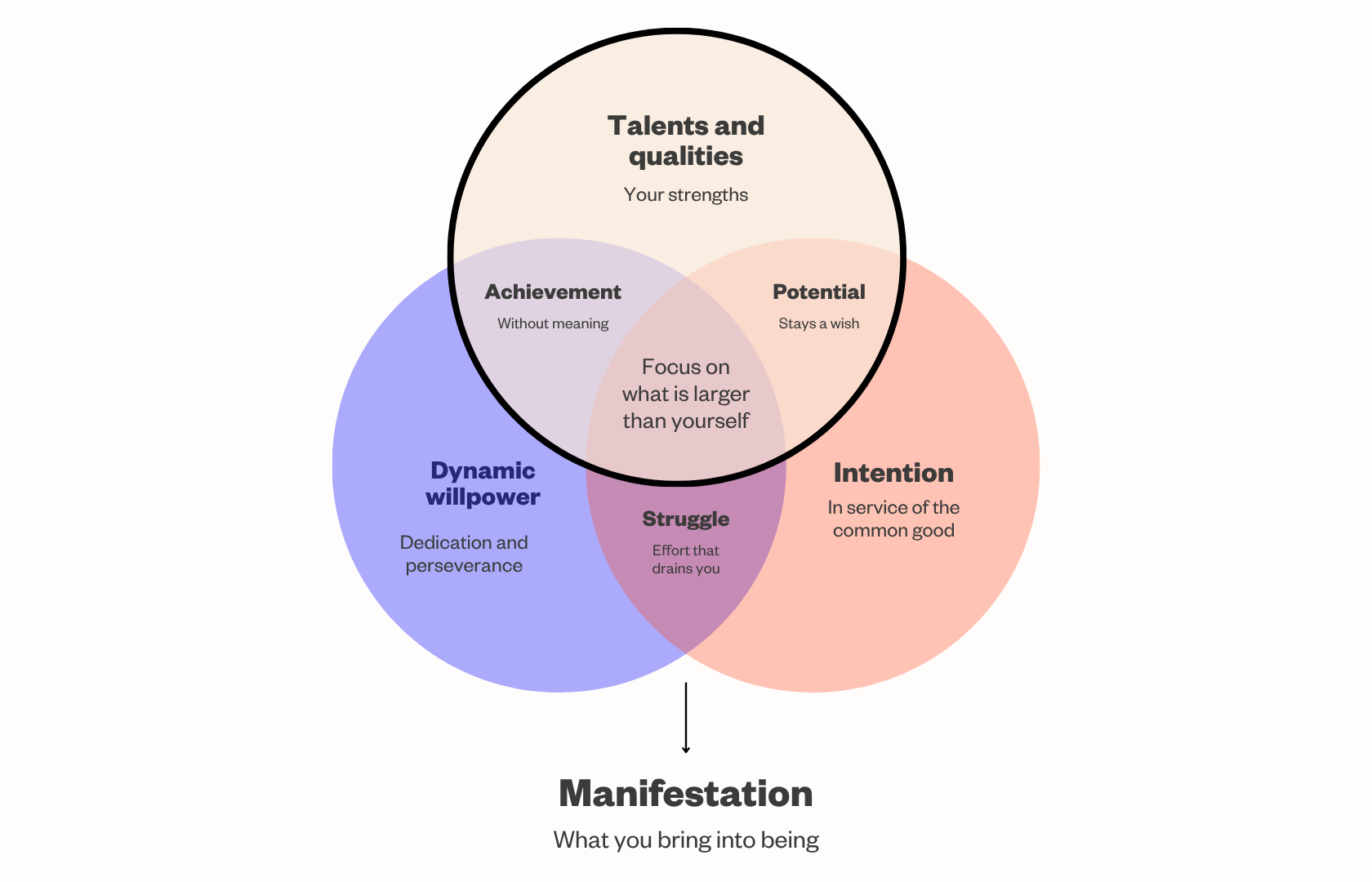
In an earlier piece, called "From wish to will," I shared the model for manifestation I drew. It shows how your strengths, dynamic willpower, and an intention that serves something larger than yourself work together. This piece explores the strengths circle.
Some natural strengths can be surprisingly difficult to see. We may assume everyone approaches things that way, or give little value to something precisely because it does not feel particularly difficult.
The default of fixing what is missing
When we think about growth, we often start with what needs improving: a skill we lack, a habit we cannot maintain, or something we feel we should already know. Much of our education and working life trains us to look at ourselves this way. We learn to close gaps and meet requirements, and can become quite good at describing where we fall short. If we mainly notice what we cannot do, repeated difficulty can start to feel like confirmation that we are not capable. That can undermine our confidence and make us less willing to try again. Over time, we may stop giving ourselves opportunities to discover otherwise.
And it can also distract us from where our focus should actually be. The obvious opportunity for growth: developing the strengths and abilities we already have.
Some of those gaps deserve our attention. But we also need to ask where the idea that something is missing comes from. Is it something we need for our own path, or are we measuring ourselves against someone else and trying to become more like them? If you find yourself doing that, think about this: if you actively try to be like somebody else, what is the meaning of your existence?
For me, growth begins with what we have been given: the strengths and abilities that come naturally to us. They are worth developing simply because they are ours, and exploring what we can do with them is part of finding our path. It helps you understand what you find fulfilling in everyday life and how you want to relate to the people around you. Your authentic contribution grows within that wider picture: how you use your natural strengths in your own life and what you bring to others through them.
You probably have a pretty good sense of who you are, but even then, you may not fully recognize or understand your strengths. Thankfully, there is a straightforward and incredibly helpful way to explore them, wherever you are in that process: the free VIA Character Strengths Survey at viacharacter.org. This is a scientifically developed and validated questionnaire that takes around ten to fifteen minutes to complete and shows how all twenty-four character strengths in the VIA framework rank for you. This gives you something very solid and concrete to work with. The free results give you a really good starting point, but I can really recommend exploring them in more depth with the Total 24 Report. It comes at a relatively small fee, but it offers more detailed explanations of your strengths and practical suggestions for using them in everyday life.
The VIA Institute on Character is a nonprofit organization dedicated to the science and practical application of character strengths. The work was developed by fifty-five social scientists, led by psychologists Christopher Peterson and Martin Seligman.
They explored the world’s major religions, philosophical traditions and psychological work in search of a complete picture of what is universally seen as virtuous: which qualities have people valued in a good human being across cultures and throughout history? Their sources included Buddhism, Taoism, Hinduism, Islam and Judeo-Christian traditions, as well as thinkers such as Aristotle, Plato and Confucius.
That work became Character Strengths and Virtues, published in 2004. The resulting framework describes six broad virtues: wisdom, courage, humanity, justice, temperance and transcendence, expressed through twenty-four character strengths. What draws me to it is the breadth of that foundation: a systematic effort to bring different traditions and psychological research into a shared framework for understanding human qualities.
What I mean by strengths
So, when I say strengths, I’m specifically talking about character strengths: the positive qualities that are expressed in how you think, feel and act. The VIA Institute describes them as central to your identity, natural to express, and energizing to use. You might notice them in the questions you keep asking, the way you help someone see a situation differently, or how readily you bring others into a conversation.
These qualities can be familiar enough to seem unremarkable. But what feels ordinary to you may be exactly what someone else values in being around you.
Being capable and feeling connected to what you do
You can be good at something without wanting it to fill your life. Perhaps you have become competent through years of practice, or because a situation required it of you. That competence is real, but it does not automatically tell you what you want to give more of your time and energy to.
It is worth asking two questions alongside each other: what can I do well, and when do I feel most like myself while doing it? There may be considerable overlap, which is great. But where there is not, that is useful information too.
Knowing your strengths also plays into the other two circles of my manifesting model. It probably won't immediately and in itself show you your path or intention. But it can really help you in exploring and getting to know your direction, recognizing opportunities, and gives you the tools for how you approach the work when they arise.
For example, if curiosity and a love of learning come naturally to you, an invitation to help someone explore a subject might appeal to you, even if you have never considered teaching. If kindness and social intelligence are among your strengths, you might find yourself helping people feel comfortable in a group, and discover how much that means to you and to them. Paying attention to those experiences can help you recognize a direction you might otherwise have overlooked.
Knowing your strengths also helps you understand why some ways of working give you energy while others drain it. In the model, the overlap between willpower and intention without the use of your strengths is what ends you up with “struggle.” Using what comes naturally to you can give you energy. Relying mainly on strengths that come less naturally can drain that energy, and the resulting struggle can wear down your willpower.
And, without knowing your strengths, the intention you develop or adopt might be less authentic to you, or less aligned with what is meant for you, however you choose to see it.
This is how the circles begin to work together. Your strengths give you part of the self-knowledge from which you can explore a direction. Your intention connects that contribution to a direction that serves something larger than yourself, and your will is the dedication you bring to pursuing it. As you act, you discover more about what feels fulfilling, what you value, and how you want to live. That experience can help you refine your direction in turn, even if the whole picture hasn't yet revealed itself. The model becomes a way to build your life through choices you understand and keep making consciously.
When we explore purpose in a later piece, which applies to the intention circle, both your strengths and these experiences will give you something to work with: what comes naturally, what feels meaningful, and how you can use what you have been given to contribute to the common good.
Using your strengths increases happiness
Beyond their role in manifesting and finding your direction, using your strengths to replace default with intention can also increase your happiness in everyday life, starting today.
In a study led by psychologist Dr. Martin Seligman, participants were asked to use one of their top five strengths in a new way each day for one week. The group reported increased happiness and fewer depressive symptoms, with benefits observed up to six months later. The longer-term benefits were most pronounced among people who continued the exercises beyond that first week.
A program I followed at Yale University connected the use of signature strengths to how we experience our work. In a study of employees, applying four to seven signature strengths at work was associated with a stronger sense of seeing their job as a calling.
I find the practical possibility in that more interesting than the number itself. You can look for ways to bring more of your strengths into something you already do. The task can stay the same while your way of contributing becomes more your own.
Recognizing yourself in practice
I have found working with these strengths useful in exploring myself and building confidence, and I use them in my work with others too. But I would not stop at these test results. Look for where you recognize those qualities in your life. Think of a moment when you felt fully involved, useful, or particularly yourself. What were you actually doing? What did you contribute? Which qualities helped you do it?
You can also ask someone who knows you well to describe a specific moment when they saw you at your best. A story gives you more to work with than a compliment alone. "You are kind" becomes easier to understand when someone describes how you noticed they were uncomfortable and made room for them.
Then consider where you would like to use those qualities more consciously. Which experiences, relationships or pursuits would you like to give more space in your life? How could these strengths help you explore or develop them? Knowing you are curious is one thing. Recognizing what your curiosity draws you toward, and choosing where to put it to use, connects that self-knowledge to your direction.
When a strength gets in your way
Knowing yourself also means noticing how your strengths can become unhelpful. Work on character strengths distinguishes between underuse, overuse and using a strength in a way that fits the situation. More is not always better.
I described an example in my first piece. Perspective is my own strongest character strength, and seeing or exploring how everything connects is a natural tendency for me. But wanting to see the whole picture before sharing any part of my work kept that work on my desk. The same quality that helped me develop it was also getting in the way of letting it become useful to others. The work still benefited me, but where it concerned this work specifically, it kept me from acting on my intention to contribute to the common good.
If you’re wondering why I place contributing to the common good at the center of intention and purpose, I’ll share that in a later piece.
That does not mean I need to stop making these connections. I need to recognize when that exploration serves the work and when it is delaying the next step. You might see something similar in how curiosity opens possibilities but makes it difficult to choose one, or how a wish to help leads you to take on more than you can sustain.
These are questions to explore in a particular situation. They are not reasons to turn a strength into another thing that is wrong with you.
In practice
Take the VIA survey if you would like a starting point.
For the next week, try using a signature strength in a new way each day. Afterward, notice what changed in your experience and what your action made possible for someone else. Would you like more of this in your life? What does that tell you about a direction you might want to explore?
Notice when you might need to adjust how much you use a strength. What would using it well in that situation look like?
If you would like to explore this further, I recommend Character Strengths and Virtues (VIA Classification): Your Best Self by Maximilian Rivenoak. I have found it insightful and practical for continuing to work with your own strengths. You can listen to the audiobook on Spotify.
Harzer, C. and Ruch, W. (2012).
Niemiec, R. M. (2019).
Peterson, C. and Seligman, M. E. P. (2004).
Seligman, M. E. P., Steen, T. A., Park, N. and Peterson, C. (2005).
VIA Institute on Character