
From wish to will
On how manifesting works
In my last piece, I wrote that you do not need the whole picture to begin, only a direction to hold on to. Holding on to that direction long enough to manifest what you are working toward requires will, and this piece is about what makes will last.
Paramahansa Yogananda was an Indian yogi who helped bring meditation to the West in the 1920s. He wrote Autobiography of a Yogi, the book Steve Jobs reportedly reread every year and had handed out at his memorial service. Yogananda described a wish as a desire without energy. It stays where it is, something you would like someday. A wish becomes an intention when you make a plan to fulfill it, and it becomes will when you decide to keep going until it is fulfilled.
Pressure or purpose
The default answer to how you get to where you want to be is more discipline, and that usually comes down to pressure. Some of that pressure comes from yourself: telling yourself you should, and pushing harder. On a smaller scale, you can think of going to the gym because you would feel guilty if you didn't, rather than because you enjoy feeling strong. Or, on the scale this is really about, pursuing what you want to achieve or be in life because you feel you should, rather than because someone truly matters to you.
A review of several studies on how people pursue their goals found that pushing yourself out of obligation did little for actual progress, while pursuing a goal because it mattered to you did. Some of it comes from outside, through rewards and the expectations of others, like a bonus, or a path you follow simply because it is what the people around you expect (see how defaults come in again here?). Choices made for you rather than by you, and exactly the kind worth replacing with intention.
Research combining over a hundred experiments found that external rewards often undermined people's own interest in an activity, so that once the reward stopped, they did less of it on their own. Either way, pressure alone is not the path that gets you there. That is not to say you should stop pushing. Dedication and perseverance are an essential part of manifesting. Whether will lasts has less to do with how hard you push than with what it runs on.
A model for manifesting
A while ago I drew this out for myself as a model for manifesting, as I understand things best when I can see how they connect, and understanding why something works gives my trust in it an additional foundation. By manifesting I mean bringing something into being by consistently directing your intention and energy toward it. It is often seen as something spiritual, and believing that what you work toward is part of something larger can give a natural dedication: research found that people who saw their personal goals as sacred reported putting more effort into them and finding them more meaningful. But manifesting does not depend on that belief. Much of it can be understood through how goals, motivation and attention work. In any case, it’s not wishing for something and waiting for it to arrive.
In my drawing, three circles feed into one center. One holds your natural talents and qualities, the strengths you were given and have grown through your life. One holds dynamic willpower: dedication and perseverance (chosen and renewed rather than forced). And one holds intention, specifically in service of the common good.
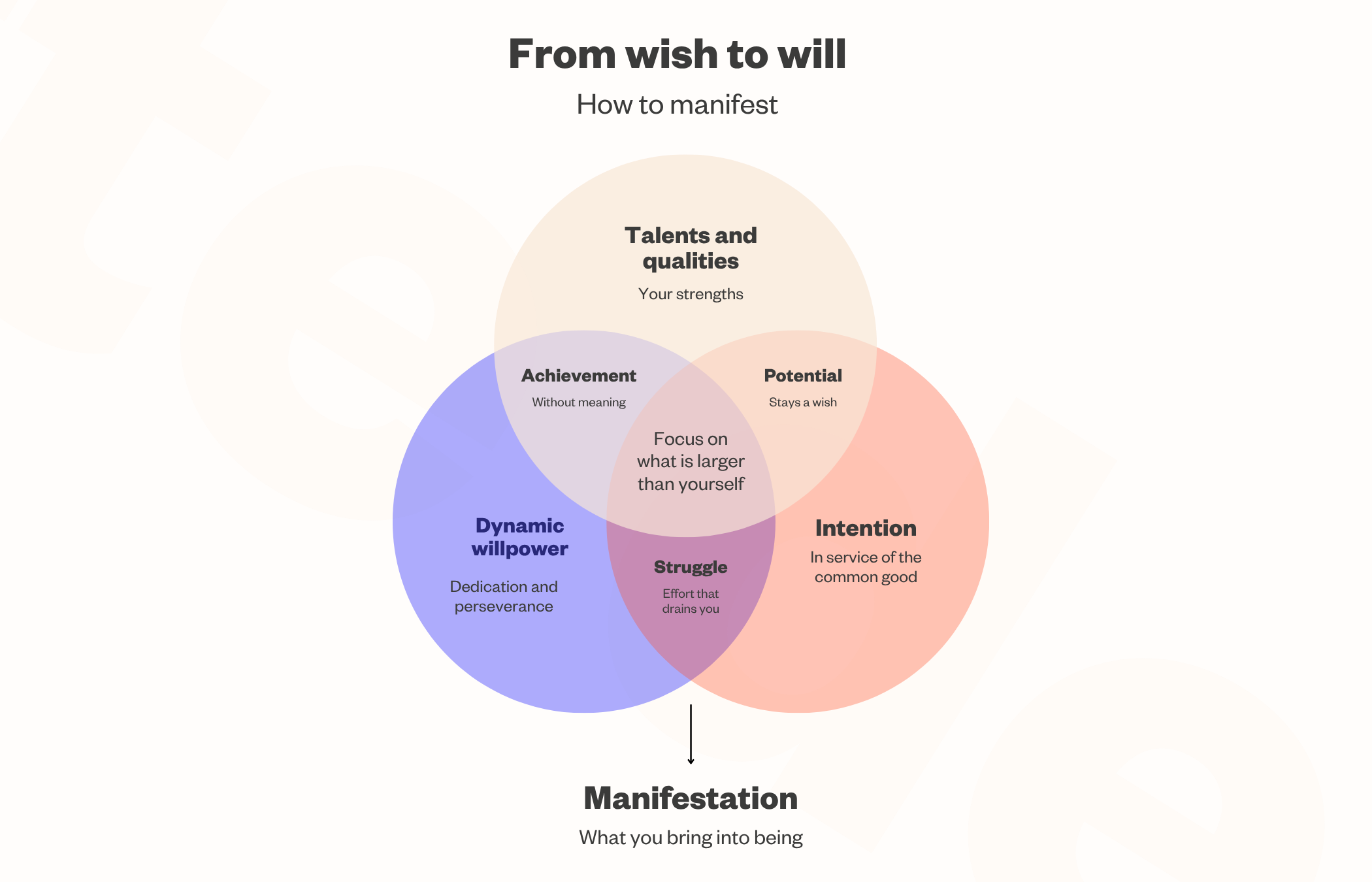
What will runs on
Each of those circles has research behind it, too. Goals that reflect your own values were found to receive more sustained effort and to be achieved more often than goals pursued out of pressure or expectation. Reaching them also left people happier, while reaching the others did so far less. Another study found that people who used their signature strengths while working toward their goals made more progress, and that this progress in turn raised their wellbeing. When your will works through your strengths, progress takes less energy, because you are building on what comes naturally to you.
The common good may be the most surprising source. In a series of studies, students who saw their schoolwork as a way to contribute to something beyond themselves kept going longer on tasks that were boring but important. An intention that serves others is not only the ethical choice, but a source of willpower in itself.
And, these sources can strengthen each other. A study among firefighters and fundraisers found that people who wanted to help others persisted longer and achieved more, especially when they also found the work interesting in itself. The student studies showed something similar: students did best when a purpose beyond themselves was added to their personal reasons for learning, while personal reasons alone, like wanting an enjoyable career, did not consistently help them keep going.
This connects to the distinction between a hedonic and a eudaimonic life. Hedonic pursuits aim at pleasure and comfort. Eudaimonic pursuits aim at meaning, growth and living by what you value. Research found that pleasure tended to give a quicker lift, while pursuits driven by meaning tended to leave a deeper and more lasting sense of wellbeing. People whose lives held both did best of all.
Focusing on what is larger than yourself even shows up in the brain. In brain imaging studies, people who first reflected on the wellbeing of others showed more activity in the ventromedial prefrontal cortex, an area involved in valuing what matters to us. It sits behind the forehead, where yogic tradition places the "third eye." Those same people were more open to advice that was otherwise hard to hear, and went on to actually change their behavior, in advantage of their pursuit.
What is larger than yourself
The three circles come together in the center: keeping your focus on what is larger than yourself. For some, that is the common good, the people their work serves or the world they want to leave behind. For others, it is God or holds another spiritual meaning. Either way, it does the same thing. It keeps your talents, your will and your intention pointed in one direction. And when what you work for is larger than yourself, how it turns out for you personally tends to matter less. That makes it easier to give it your all without clinging to the outcome. It is where the surrender from my last piece lives.
A wish asks what you would like and stays where it is. Will asks what you are willing to give yourself to, and moves you ahead.
In this piece, I talk about strengths, intention and purpose. If you are not yet clear or sure on what your strengths are, or what you want to give yourself to, that is where to begin. In the coming pieces, I will share how to discover both: your strengths, and the purpose your intention can grow from.
Replace default with intention
Deci, E. L., Koestner, R. and Ryan, R. M. (1999)
Grant, A. M. (2008)
Huta, V. and Ryan, R. M. (2010)
Isaacson, W. (2011)
Koestner, R., Otis, N., Powers, T. A., Pelletier, L. and Gagnon, H. (2008)
Linley, P. A., Nielsen, K. M., Gillett, R. and Biswas-Diener, R. (2010)
Mahoney, A., Pargament, K. I., Cole, B., Jewell, T., Magyar, G. M., Tarakeshwar, N., Murray-Swank, N. A. and Phillips, R. (2005)
Falk, E. B., O'Donnell, M. B., Cascio, C. N., Tinney, F., Kang, Y., Lieberman, M. D., Taylor, S. E., An, L., Resnicow, K. and Strecher, V. J. (2015)
Kang, Y., Cooper, N., Pandey, P., Scholz, C., O'Donnell, M. B., Lieberman, M. D., Taylor, S. E., Strecher, V. J., Dal Cin, S., Konrath, S., Polk, T. A., Resnicow, K., An, L. and Falk, E. B. (2018).
Sheldon, K. M. and Elliot, A. J. (1999)
Yeager, D. S., Henderson, M. D., Paunesku, D., Walton, G. M., D'Mello, S., Spitzer, B. J. and Duckworth, A. L. (2014)
Yogananda, P. (1944)