
Replacing default with intention.Discovering your life’s purpose
On knowing yourself, finding meaning and contributing to something beyond yourself
Everything I write comes down to one thing: replacing default with intention. Default is what you do without choosing it, repeating what was done before or what others do. Intention is consciously committing to a direction. Each piece approaches it from a different angle, and together they build toward an authentic, happy and meaningful life.
In the last two pieces, I wrote about getting to know what comes naturally to you, and remaining open to what you can become. We now turn to purpose, and with it, the intention circle in my manifestation model: what your strengths and dynamic willpower serve, what you apply them to.
As you understand yourself better and pay attention to what life brings, what feels meaningful to give yourself to? What matters enough to guide how you live? For me, purpose includes what you value, the way you live those values, and what that makes possible for others. It helps you understand what gives your own life meaning, and how you can live in accordance with that.
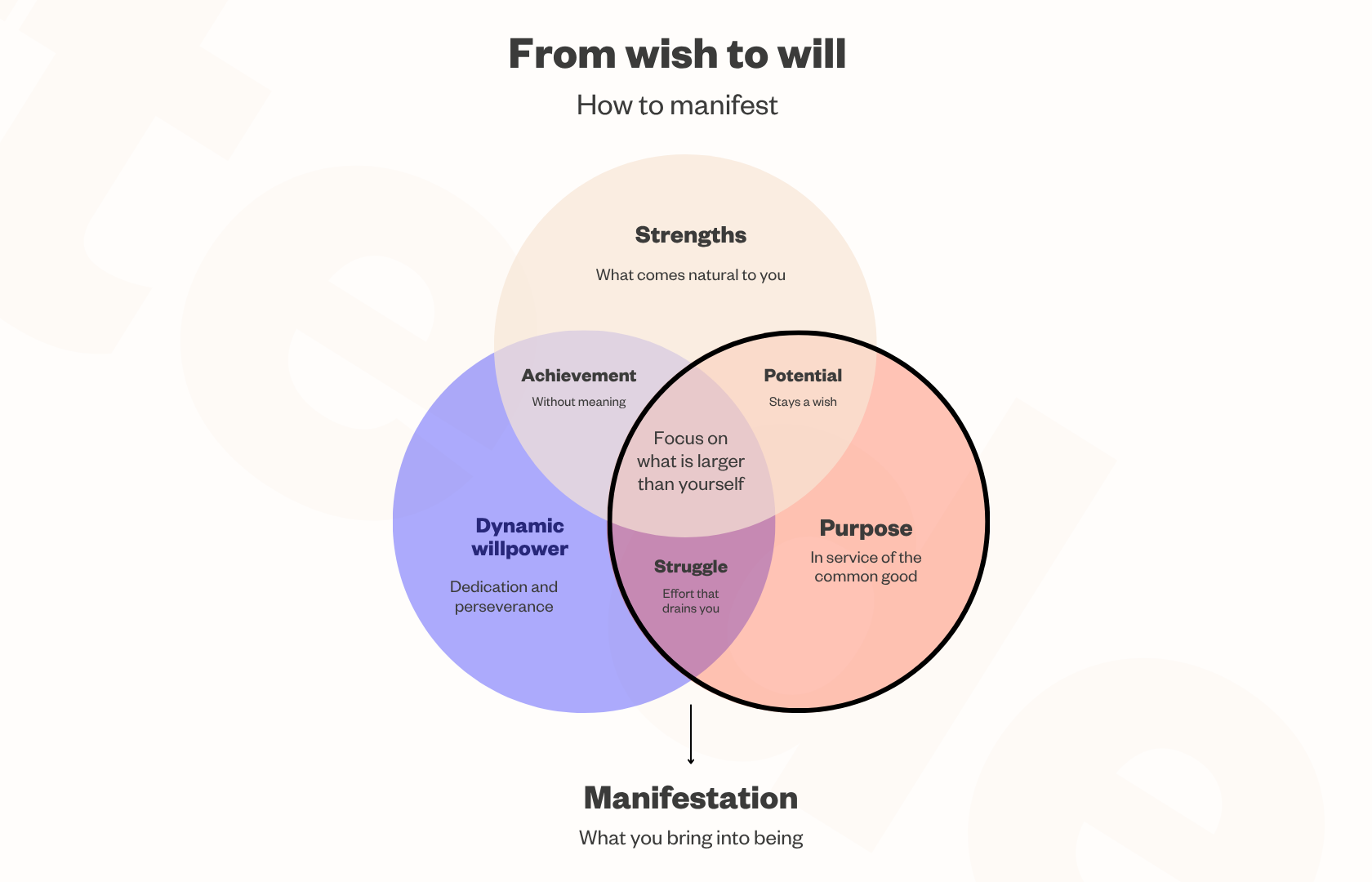
Exploring these questions helps you fill that intention circle with something that feels authentic to you and serves the common good. It gives you a clearer sense of what you bring your strengths and willpower to, while leaving room to recognize and respond to opportunities as your path unfolds.
For as long as I can remember, I have been asking questions about existence. What am I doing here? Why does any of this exist? How can the universe have no end?
It was only in my late twenties that I began actively exploring these questions. Over the years, I have learned from many different books, programs, courses, and spiritual teachings. Most of my studying focused on quantum physics and consciousness, but I didn’t limit myself to what we consider proven knowledge. Some years into that exploration, I also followed a program on purpose and meaning in life from the University of Michigan.
As my views developed, I felt the familiar urge to organize what I was learning, make the connections clear, and see how it all fit into a bigger picture. That is my perspective strength in action, as I explored in the piece on not needing the whole picture. It can also lead me to keep trying to complete the picture, needing to understand its full context and end result, before putting anything into practice. I wanted to bring that understanding together around the questions I had been exploring all along: what gives my life meaning, and what do I feel called to contribute?
One of the things I developed was a model I call the Well. It draws on what I learned in that program, alongside my own reflections and spiritual understanding, to connect purpose with how we live and what we contribute. Its name is inspired by a hexagram in the I Ching, an ancient Chinese book of wisdom that I turn to for spiritual and philosophical guidance.
Later, we’ll also look at brain research showing activity in an area behind the forehead, near where the third eye is traditionally pictured.
The default of waiting for a calling
Purpose can sound like one big calling: a particular profession, a cause to devote your life to, or something you are supposed to discover before you can begin.
I can understand why we might want that kind of clarity. When a purpose feels clear and tangible, it may be easier to trust it and follow it.
Looking at someone who has been drawing since childhood and becomes an artist, we might think: of course, they were always going to do that, they're naturally talented. Their direction seems obvious. And when we compare that with our own lives, we may feel that we are missing something because we do not have an equally clear answer.
But most people don’t, otherwise those talents wouldn’t be special, and as I explored in the previous piece, what comes easily is only part of the story. A recognizable talent may help someone find their direction. For others, that direction becomes clearer through exploring what feels meaningful and paying attention to what life brings.
If we wait until our purpose feels completely clear before we act, we return to something I explored in the first piece on the whole picture. We may already recognize something that feels meaningful, but hesitate because we cannot yet see where it will lead. In doing so, we can overlook what life is offering us now, because we expect our purpose to arrive as a clear and complete answer.
I believe a direction can be given through paying attention and surrendering to what life brings. Getting to know yourself helps you recognize it. But you cannot discover everything through reflection alone. You need to begin, create, and experience what happens when you put something into practice. Through doing, you discover more about yourself and the direction taking shape. You can begin with what is already present in your life, without knowing in advance what the whole of it will become.
Professor Victor Strecher, who taught the Michigan program, describes purpose as the roots of a tree, with the tree representing the life we live. Exploring purpose is a way of getting to know those roots: who we are, what we value, and what we feel called to contribute. We may recognize things that feel meaningful without yet understanding how they connect or what direction they suggest.
That gives us a reason to explore purpose wherever we are in that process. If your direction is still unclear, these questions can help you begin to recognize what matters most to you and give shape to your intentions. If you already have a sense of your purpose, returning to it can help you deepen and refine that understanding.
It also helps us recognize the distance that can arise between what we value and how we live. We can become so occupied with demands, expectations, and habits that we keep doing what is expected or familiar without considering whether it still reflects what matters to us. This is another clear example of default replacing intention, instead of the other way around. Exploring purpose helps us recognize that distance and bring intention back into how we live.
Understanding why something feels meaningful to give yourself to can also help you trust the direction, even while its outcome remains uncertain.
In Man’s Search for Meaning, Viktor Frankl quotes Nietzsche: “He who has a why to live for can bear almost any how.” Knowing what we are giving ourselves to helps us persevere when circumstances become difficult.
“When one can no longer see, one can at least still know.”
–‘After the ecstasy, the laundry’, a book on life after enlightenment
Research offers another perspective on that steadiness. A study, drawing on two large samples totaling 3,664 people, looked at childhood emotional abuse or neglect and depressive symptoms in adulthood. The connection between those childhood experiences and later symptoms was weaker among people with a stronger sense of purpose.
For me, this is why exploring purpose belongs in a conversation about manifestation. It helps us understand what we are bringing our strengths and willpower to, and why: something that feels meaningful and contributes to the common good. And it helps us understand why we are doing so, which in turn can sustain our willpower, helping us remain dedicated even when things become difficult or uncertain. That is how I understand manifesting on the scale of life: living an authentic, happy and meaningful life through what we give ourselves to now. Finding meaning and satisfaction in the process is already living our path. It does not depend on a future achievement.
Begin with who you are and what you value
Strecher offered two questions as a starting point for exploring your purpose: who am I, and what do I value most?
The first exercise asks you to think about yourself when you are at your best. What are you like then? Perhaps you listen with patience, bring people together, or become absorbed in understanding something. Understanding your character strengths and recognizing how they show up in your life, as we explored in my earlier piece on natural strengths, will help you answer exactly those questions.
The next question is what you value. What matters to you? What do you love to experience? Which people, causes or ways of living do you care about?
Thinking about the following questions and putting your answers in writing can help you explore your purpose:
What matters most in your life?
Who relies on you? Think about everyone who does or might in any situation.
What do you want to be and mean to those people?
Who inspires you? This could be someone you know or a public or historical figure.
What causes do you care about?
What are you grateful for?
What gets you out of bed in the morning?
How do you want to be remembered?
For that last question, the headstone exercise makes it more concrete: if your life ended today, what would you want written on your headstone? Those few words can help you recognize what you most want your life to stand for.
You can also turn that question around. If you continued living as you do now, would you feel satisfied looking back on how you had lived? What would you wish you had given more attention to, or less? Thinking about what you do not want your life to become can help you recognize what deserves attention now.
And honestly, it’s not going to be “They proudly spent their life in a rat race.” We give urgency to things because we are told they are urgent. But do we actually think they deserve that place in our lives? That again is default taking over. For me, exploring purpose means questioning that directly, and bringing our attention back to what we actually value. You’ll then have a framework for recognizing what deserves urgency in your life and what does not.
Looking at your answers alongside the strengths you’ve identified can help you see connections. Which themes keep appearing? Where do you see a connection between what comes naturally to you and what matters most?
Perhaps you describe yourself as someone who listens carefully. You value connection, people turn to you when they need support, and you want to be remembered as someone who helped others feel understood. Together, those answers begin to suggest a direction: helping people feel heard and connected.
Putting into words what you recognize so far gives you something to explore and put into practice. You do not need a complete or final answer to begin living with it.
From what you value to how you live
Once you begin to recognize what matters most to you, the next question is how that becomes part of the way you live. This is where the distinction between your purpose, “be goals,” “do goals,” and “actions goals” becomes useful.
“Be goals” describe the kind of person you want to be in your life and relationships, based on what you value. One example from my own life is wanting to be an abundant caretaker and provider for my kids so they have the best foundation to thrive in life and approach the world with compassion and in awareness of their own beauty.
“Do goals” describe what living that way involves: being there, listening, dedication to my career, and maintaining a balance between work and the rest of life that allows me to be present.
Action goals make that specific. Sleeping well, eating healthy, and working out support my ability to keep showing up and manage those responsibilities. Protecting time together and blocking time for meditation help me put that balance into practice. These actions connect the required maintenance of caring for myself with the care I want to offer my family.
Another part of my own purpose, which I will share more on further down, provides another example of how these levels connect:
Be: An admirer of life.
Do: Continue learning and developing spiritually.
Action: Read, study, write, meditate, sufficient alone-time.
Reading and studying help me explore and understand more. Meditation and time alone support paying attention to my experience and my spiritual development. They are ways of putting into practice how and who I want to be in life.
What I have put into my purpose map, across the be goals, do goals, and actions, ties in remarkably beautifully with my VIA strengths. My top strengths include love of learning, which keeps me curious; perspective, which helps me connect what I learn; and spirituality, which is part of how I make sense of it. Kindness and humor also shape how I share that understanding and connect with others. These strengths do not tell me exactly what to do, but they help me recognize how I can express what matters to me. For me, they help confirm the connections I recognize in my purpose map—or perhaps complete the circle.
The same connection can help you look at your own answers to the earlier questions. If something matters deeply to you, how would you want that to show in the person you are? What would living that way involve? And what specific actions could give it a place in your everyday life?
Making those connections helps you begin to understand and put your purpose into words., and, putting what you recognize into practice gives you experience to learn from: what feels meaningful, what helps you express your strengths, and what your actions make possible for others. Through that experience, your understanding of your purpose can continue to develop.
Meaning for you and a contribution beyond you
Purpose researchers William Damon, Jenni Menon, and Kendall Cotton Bronk describe purpose as an intention that is meaningful to you and also has consequences beyond yourself. It connects what gives your own life meaning with what you contribute to the world around you.
In my manifestation model, purpose is in service of the common good and helps you shape and test your intentions. Helping each other thrive is what life is about. We learn from others, receive their care, and benefit from what people before us have understood and created. What we have been given can, in turn, become something we offer. Our strengths, knowledge, experience, and care can make something possible for someone else.
That is why contributing belongs in my understanding of purpose. It gives expression to who we are in a way that reaches beyond our own experience. A conversation can help someone understand themselves differently. Something we create can open a possibility for another person. What we offer may continue through what they then offer others. This is the kind of chain reaction I feel called to contribute to.
This connects to the distinction between hedonic and eudaimonic wellbeing that I introduced in the earlier piece on willpower. Hedonic wellbeing concerns pleasure and enjoyment. Eudaimonic wellbeing concerns meaning, self-realization, and living fully. Research suggests that these offer partly different benefits: pleasure can bring immediate enjoyment, while activities centered on meaning and developing what is best in ourselves can contribute to wellbeing over time.
Purpose connects particularly with that second understanding. It gives us something meaningful to live by, including when what we are doing is difficult or uncomfortable. This is when willpower (perseverance and dedication) comes in, which I’ll talk about in a later piece. The fulfillment comes through expressing what we value and contributing to what we feel called to serve. Enjoyment can be present in that experience too. Helping someone may feel good while also expressing something deeply meaningful to us.
What nourishes us and what we contribute can support each other. Learning can bring us joy and deepen what we are able to share. Caring for ourselves supports our ability to give. And seeing what our contribution makes possible for someone else can itself be deeply fulfilling. Your own wellbeing belongs within the common good, too. My purpose map ‘The Well’, which I’ll address further down, brings those connections together.
What brain research adds
The connection between knowing yourself and understanding what you value also appears in brain research. Specifically in the ventromedial prefrontal cortex, or vmPFC, an area involved in both thinking about ourselves and evaluating what is valuable to us.
In one brain-imaging study, participants reflected on important personal values, particularly on expressing those values in future situations. This engaged brain systems involved in thinking about themselves and in experiencing value and reward. At the same time, they received messages encouraging them to be more physically active. Greater activity in those brain systems during the reflection was later associated with spending less time sitting in the following month.
The connection to behavior is what interests me here. Reflecting on what matters was followed by advice about something people could change in their daily lives, and the brain responses during that reflection were linked to how much their behavior changed afterward. This does not show that answering our purpose questions will automatically change our lives, but it helps explain how keeping our purpose and the common good in focus can strengthen our willpower. That focus can help us persevere with our “action goals” through which we live our purpose.
The vmPFC is located in your “third eye” area. Professor Strecher referred to this as the “guru” part of the brain. He also introduced the spiritual idea of Atman, which he described as the god-like self. I find that a meaningful spiritual comparison when considering who we are beyond our roles, self-image, and physical body.
There is also a connection with the research I mentioned in my earlier piece on willpower. Health advice can be difficult to hear when it points out that something we do needs to change. In that study, people first reflected on important values beyond themselves or made positive wishes for others, and then received advice about becoming more active. Both groups became more physically active over the following month compared with the control group. While receiving the advice, they also showed greater activity in parts of the vmPFC involved in thinking about themselves. The researchers interpreted this as a sign that the advice was being processed as more personally relevant.
The idea is that turning our attention toward what matters beyond ourselves may help us hear advice as something useful, rather than as a threat to the way we see ourselves. This, importantly, points to a way in which you can practice not letting the ego take over. In life, I believe learning to recognize and being able to stop the ego from taking over is essential. Letting the ego lead is a default too: we react to protect our self-image, and that can get in the way of living our purpose and connecting with others. Replacing that default with intention means returning our attention to what we serve beyond ourselves. Which in turn can support both our openness to learning and our willpower to act on it. I will explore this further in a later piece on ego.
Loving-kindness meditation offers a way to practice that attention to others: bringing someone to mind and wishing them well. A separate study found that a program teaching this practice increased daily positive emotions over time. Those increases were linked to gains in personal resources, including a sense of purpose, which in turn predicted greater life satisfaction and fewer depressive symptoms.
I personally found loving-kindness to be not only beautiful, but a very efficient and effective way to deal with frustrations in life. Frustration is an energy we should not wish to keep feeding, yet we default to that all the time. When we are caught up in frustration, our attention is occupied by what bothers us. This drains the positive energy we want and need to feed our willpower, and pulls us away from our intention.
This gives us a perspective on how happiness, purpose, and practice can support one another. We can explore what matters through reflection, express it through action, and develop ways of paying attention that help us remain connected to it. I will return to loving-kindness and other practices when exploring happiness in a next piece.
My way of bringing this together
I used these questions and the distinctions between being, doing, and specific actions to explore my own purpose. But for me, meditation was also part of how that understanding came to me.
Around the time I was exploring these questions about purpose, a situation that had happened a while earlier came back to me during a meditation. In a group setting, someone had expressed doubt about herself, describing something she sometimes did and hated about herself. I had reframed it for her, helping her recognize it as an overuse of a strength. Because of that, she could see the good in that quality, while also recognizing that she could practice having more control over how she expressed it. During the meditation, I could really see clearly for the first time what had happened in that exchange and what it had meant for both her and me.
What struck me was how my own strengths and values made that contribution possible. Love of learning is one of my strengths, and I deeply value learning from others and from the wise who came before us. The knowledge I had gained allowed me to help her understand herself differently. Something she disliked about herself became something she could appreciate and learn to use with more balance. In that situation, I was able to show her her beauty. Having it played back to me, helped me recognize a connection between what comes naturally to me, what I value, and what I feel called to contribute. Possibly, you will also start to recognize these situations in your life as you process, explore, and sit with your answers to the earlier questions.
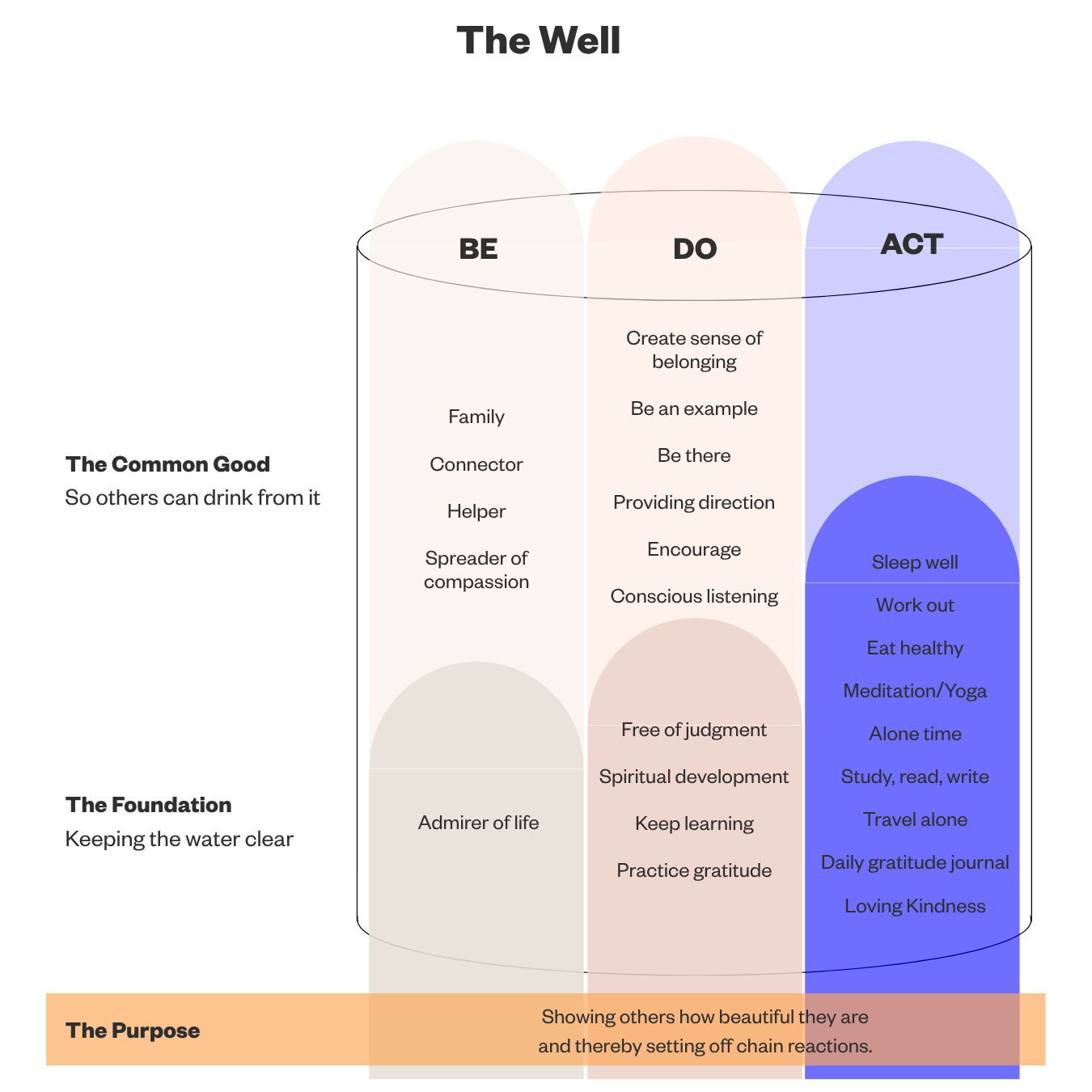
‘The Well’ is my way of bringing that understanding together. At its base is my life’s purpose: Showing others how beautiful they are and thereby setting off chain reactions. I wish to show others their strengths, point them to their essence, and help them appreciate the beauty and complexity of life and of themselves. Spreading love. In the trust that they will, in turn, do the same for others. Bringing more perspective, love, compassion, empathy and appreciation into the world.
My purpose describes a direction I intend to live by, and an intention I can bring to many different situations. It does not describe one particular thing I need to create or a result I will eventually reach.
It might take form through my writing, through my business, through bringing people together, or through a conversation that helps someone recognize their own strengths. There is no single task that completes it. The way I express it can change with what life brings, while the intention behind it connects those different expressions. That is also how purpose leaves room for surrender: I can recognize what I want to serve without knowing in advance all the ways it will take shape.
I think about the possibility of doing something good for someone who then passes that on, potentially touching many more lives. That possibility makes me deeply happy. That is what I want to contribute through the way I meet people.
Above that purpose, the Well has two connected parts. The foundation is about keeping your water clear: what nourishes you and helps you live with awareness. It holds what you need to sustain your ability to serve the common good. In my Well, that includes learning, gratitude, spiritual development and the practices that support them.
The upper part is about the common good: allowing others to drink from the well. In my Well, that includes being (be goals) a connector, a helper, and a spreader of compassion. It takes shape through (do goals) conscious listening, encouragement, providing direction and creating a sense of belonging.
The “act” column identifies the specific actions that put your do goals into practice. These are the things you do regularly to sustain the way you want to live: the everyday actions through which you live your purpose.
Keeping the water clear and letting others drink
What I find useful about this image is that it keeps caring for yourself and contributing to others connected.
In my own Well, many of the concrete actions are on the foundation side: sleeping well, exercising, meditating, studying, writing and having time alone. They support how I am able to meet life and other people. Likewise, giving asks us to remain attentive to what sustains us. If I keep helping while ignoring my own need for rest or space, I may have less patience and attention to offer. Both parts of the Well ask for care. We need to keep the water clear for others to be able to drink from it. We care for ourselves, in service of the common good.
The Well in the I Ching
Through a course I took on ancient Chinese philosophy at Harvard, alongside my own reading and spiritual practice, I encountered teachings that offered me different ways of understanding life, purpose, and how we respond to what life brings. I learned about the I Ching, the ancient Chinese Book of Changes, specifically, through Carl Jung’s writing on synchronicity. He actually also wrote the foreword in the Wilhelm–Baynes translation of the I Ching.
My model is inspired by a hexagram called the Well, from that ‘oracle’ book. Its image offered another way for me to consider purpose.
Its ‘changing lines’ describe: a well whose water is unusable; one that has been cleaned but is not being drawn from; a well being repaired; and one whose water is available to others.
Two ideas in particular speak to me. A well may contain good water, yet people still need a way to draw it. And repairing the well can require a period when it is unavailable; that care makes it possible to keep serving.
These are the ideas I built into the two parts of my model: making what we have available to others, and caring for what makes that possible. The Well connects the contribution we make with what we need to sustain it.
Another ancient Chinese book of wisdom, the Tao Te Ching, offers an image of water that speaks to the same understanding of contribution. In its eighth chapter, the highest good is compared to water, which benefits all things without competing and flows to low places others avoid. What speaks to me is the way water nourishes what it reaches, without needing recognition for doing so. That is also how I want to understand what I give: through what it makes possible for others.
Living your purpose as your path unfolds
In my manifestation model, purpose helps you explore what your intentions serve, giving you a reason to bring them into being and a basis for checking whether what you pursue remains aligned with what you value and feel called to contribute. Your strengths help you recognize what you bring, and your dynamic willpower helps you continue to put in the work.
For me, this leaves plenty of room for surrender. Knowing my purpose does not tell me where life will lead me, or who exactly I will be or what I will accomplish. But it gives me clarity on the path to follow, dedication to the steps that I choose and the opportunities that arise for me, and meaning along the way.
In practice
The questions earlier in this piece offer a starting point. Putting your answers in writing can help you see what returns across them, including what you value for yourself and what you hope to contribute to others.
From there, you could put “be goals” into words that feel like yours. For each one, what would living that way involve? What “do goal” would support it, and which specific actions or habits could put it into practice? You could then bring these connections together in your own Well. Which actions keep your water clear, and how does that support what you give to others?
A first sentence describing your purpose can grow from what you recognize. You can live with it, act on it, and return to it. Does it still feel right? Is something missing? Can you express it more clearly? Your understanding may develop as you come to know yourself and life better. If done right, it never becomes set in stone.
Cascio, C. N., O'Donnell, M. B., Tinney, F. J., Lieberman, M. D., Taylor, S. E., Strecher, V. J. and Falk, E. B. (2016).
Damon, W., Menon, J. and Bronk, K. C. (2003).
Frankl, V. E. (1946). Man's Search for Meaning, quoting Friedrich Nietzsche.
Fredrickson, B. L., Cohn, M. A., Coffey, K. A., Pek, J. and Finkel, S. M. (2008).
Hartanto, A., Yong, J. C., Lee, S. T. H., Ng, W. Q. and Tong, E. M. W. (2020).
Kang, Y., et al. (2018).
Kornfield, J. (2000). After the Ecstasy, the Laundry.
Laozi. Tao Te Ching, chapter 8.
Schaefer, S. M., Morozink Boylan, J., van Reekum, C. M., Lapate, R. C., Norris, C. J., Ryff, C. D. and Davidson, R. J. (2013).
Strecher, V. J. Finding Purpose and Meaning in Life: Living for What Matters Most. University of Michigan.
Wilhelm, R. (1950). The I Ching or Book of Changes, hexagram 48.