
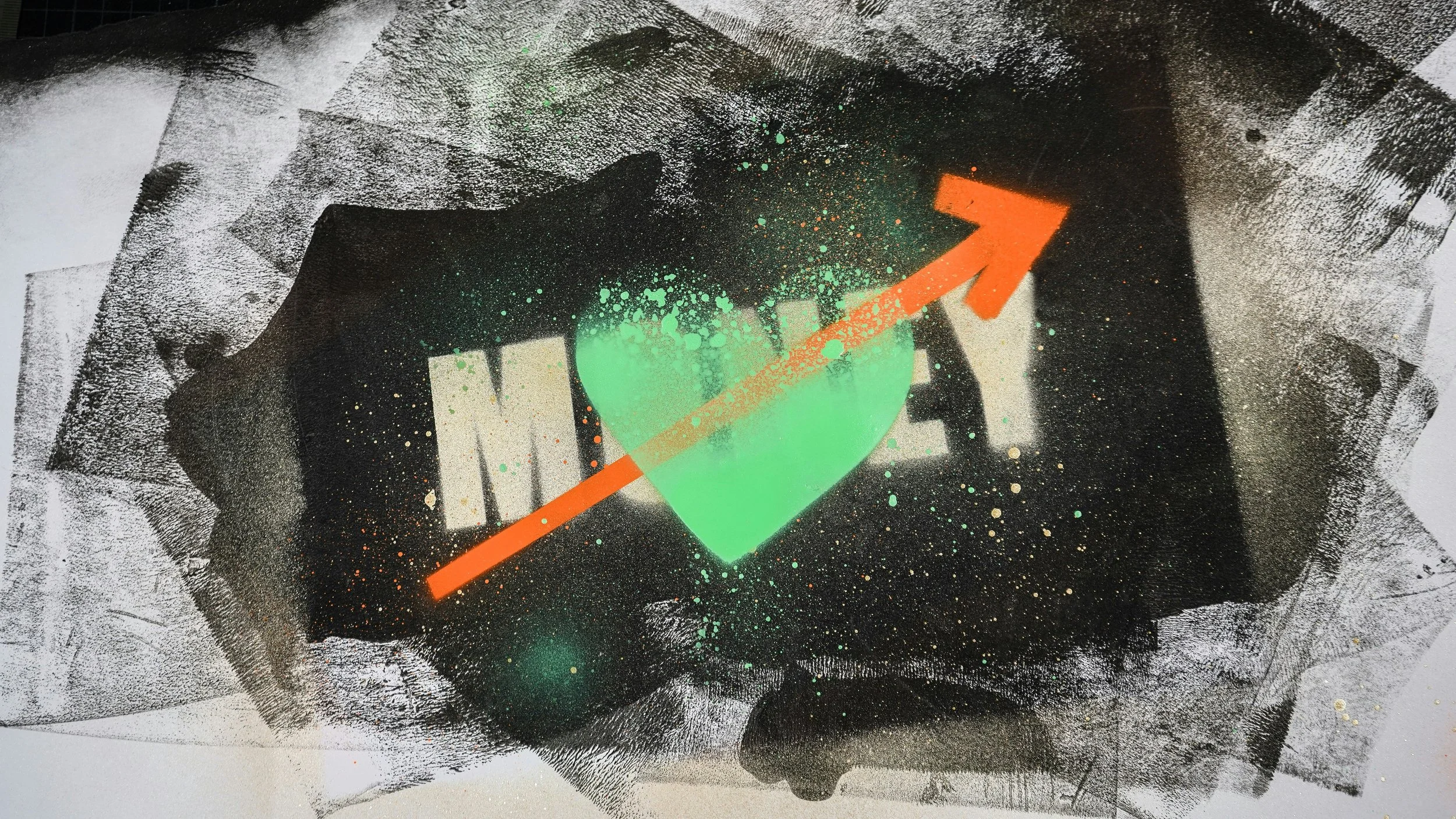
Replacing default with intention.Let go of money to make money
On attachment, trust, and our relationship with money
What must we earn before we feel successful? What can we afford to say no to? What would having more money prove, and to whom?
These questions aren't necessarily about income as much as they are about our relationship with money, what we have made it mean, and the power we give it over how we live.
Loosening that attachment has changed how money comes into my life. I experience it as coming more naturally when I am less attached to it as a source of power. Detachment seems to remove an obstacle to receiving. That is the spiritual understanding I want to explore here, alongside research that helps us examine the beliefs and priorities we bring to money.
The default: what we learned about money
Our ideas about money can feel so obvious that we don't recognize them as beliefs we have accepted by default. They are shaped by what our parents worried about, what people around us admired, and what happened when there wasn’t enough money or when there was plenty.
Perhaps we learned that money makes someone important. That wanting it is selfish. That having enough means being safe, but that there is never quite enough to feel safe. Or that we must struggle to deserve what we receive.
We also learn cultural rules about money. In some circles, talking about what you earn, own, or can afford is a way of showing success. In others, discussing money is considered impolite. We may be encouraged to display wealth while being discouraged from asking what someone earns or how they acquired it.
These different rules can all make money very powerful in our minds. Money becomes something to admire, to use to compare ourselves with others, or to feel uncomfortable discussing. And keeping it out of conversation can leave those meanings unquestioned. Yet many of us may never even consciously consider what place we want money to have in our lives.
Often, we make money far too important in how we see ourselves and one another, developing a distorted attachment to it without choosing to. It is so woven into our lives that our attitude toward money may be one of our most deeply ingrained defaults.
Can money buy happiness?
And then there is the question we encounter throughout our lives: can money buy happiness?
Years ago, I learned about a study that suggested that beyond a certain level of income, more money contributed little to happiness. Money mattered when there was not enough, but once people were financially stable, earning more would not necessarily improve how they felt in everyday life.
That understanding reflected influential research suggesting that emotional wellbeing stopped increasing above a particular income level. However, later research complicated that picture. In 2023, researchers who had previously reached different conclusions worked together to examine the discrepancy. They compared people’s incomes with their reported emotional wellbeing. Among the least happy participants, higher income was associated with greater happiness up to a certain income level, beyond which people earning more were no happier on average. Among happier participants, higher income remained associated with greater happiness.
This tells us about income, not how attached people were to money. Someone can be happy, feel little need for money to prove their worth, and still appreciate the freedom or opportunities it makes possible. Having more money and making money more important in your life are different things.
That association does not establish that increasing someone’s income will make them happier. But there’s more experiments that have also found benefits from receiving money. In one study, people given $10,000 reported improvements in wellbeing compared with those who did not receive it. People with lower incomes benefited more.
These studies concern income and receiving money, rather than attachment to it. Someone can be happy, feel little need for money to prove their worth, and still appreciate the freedom or opportunities it makes possible. Having more money and making money more important in your life are different things.
For me, that brings us back to an answer we could probably have given before looking at the research: money matters. It can help us meet our needs, deal with difficulties, and have more choice in how we live. We just should never place it at the center of our lives or make it our main motivation. We can all sense that something would be entirely wrong with that. Yet, we often do. And, money does sit at the very center of how we have organized modern capitalist society.
This also connects with what we have explored about happiness throughout these pieces. Time with people we care about. Becoming absorbed in something we enjoy. Having the attention to appreciate what is happening. The thing with money is, it can help make room for those experiences: visiting someone, learning something, or simply being more present because your mind is less occupied by financial worries.
I have been in that place of financial worry myself. And I don't see how I could have followed the same path of development if I hadn't first pursued financial success through the goals I earlier described as motivated by ego. I have since consciously chosen to change my relationship with money, but what I pursued back then also helped make that choice possible. It absolutely helped create the space for what I was able to explore and how I was able to develop personally.
That was how it happened for me. You do not have to follow the same sequence or wait until you are financially secure to begin other work. You can practice what I describe while working to relieve financial pressure, including using those practices to help you recognize opportunities, make decisions, and take steps toward improving your financial circumstances.
That is where the question becomes more personal. What would having more money allow you to experience or develop over time? Consider the space it could create to understand yourself, explore your abilities, or reconsider your direction when less of your energy is occupied with keeping everything going.
And what does pursuing it currently ask of you? Earning more might give you time with your children, or require you to spend less time with them. It might support work you care about, or keep you occupied with work that leaves little room for anything else.
We have reasons to value money’s contribution to our lives, but it is still up to us to consider what we want that contribution to be, rather than assuming that a higher number is itself the life we are looking for.
What we expect from money
That brings us back to the beliefs we carry about what money can do for us. Psychologists Brad Klontz and his colleagues use the term money scripts for beliefs about money, many of which develop in childhood. Their research identified patterns including money avoidance, money worship, money status, and money vigilance.
What I find useful is the invitation to recognize that we bring beliefs into something we may think of as purely practical. We may pursue a higher income without asking what it is meant to serve. We may feel uncomfortable accepting payment for work we care about, as though being of service and being paid cannot belong together. Yet some of the work we feel most compelled to do is precisely the work we should be funding properly.
I see this in the work I and many others do to improve the position of women and gender minorities as well as allround diversity in the quantum physics and technology space, and to create the equitable conditions needed for diversity to last. Much of this work is done for free, often by women already facing inequalities in pay and opportunity. These efforts add hours to their days on top of the disproportionate share of unpaid care and domestic work already carried by women.
We are asking the people affected by inequality to take on the additional work of addressing it, without payment. That expectation deserves to be challenged. If creating an equitable field matters, it needs a budget and people paid to do the work. Our commitment should not become a subsidy for a sector that benefits from our efforts. Yet we can internalize that expectation ourselves: if I truly care about the work, I should be willing to do it for free.
Replacing default with intention begins with noticing the relationship we have inherited. What am I expecting money to do for me? What does receiving it bring up? What do I feel I must do to deserve it?
The power we place in money
One teaching from Caroline Myss’s Anatomy of the Spirit has particularly shaped my view on this: the power we attach to things outside ourselves. Money can become one of those things: something we rely on to tell us that we are safe, capable, important, or in control.
Money does give us real possibilities, but we can also ask it to give us an inner certainty that no amount can guarantee.
This connects with the earlier piece on ego. If money must prove that we are doing well, receiving less can feel like becoming less. Someone else having more can feel like a judgment about us.
Acquiring more can easily become confused with living well. A meta analysis by Helga Dittmar and her colleagues found that a stronger materialistic orientation was associated with lower wellbeing. Wanting financial security is different from organizing your life around possessions and status. Again, money can support an authentic, happy, and meaningful life. But continually needing more to feel that we are enough can take our attention away from living it.
For me, detaching means releasing that power I have given money. I can care for it, earn it, and receive it without making it responsible for who I am. I believe this also allows money to come more freely, without my holding so tightly to what it must mean or how it must arrive.
In practice, detachment has made me less inclined to hold on to money simply for the sake of keeping it. I’ve never been greedy, but I now spend more freely when something brings me joy or allows me to bring joy to someone else. I recognize the privilege in being able to do that. Financial security gives me room to make those choices, but it does not by itself explain my willingness to do so.
What continues to strike me is that the more freely I live this way, the more opportunities and money seem to come into my life. I experience this as part of a wider relationship with life: trusting, responding to what feels right, and allowing myself both to contribute and to receive.
Allowing yourself to receive
Attachment can also show up in the conditions we place on receiving. If we believe that worthwhile work must involve sacrifice, accepting fair payment may feel uncomfortable. If we believe that caring about money makes us selfish, we may struggle to ask for what our work is worth.
For example, if you feel uncomfortable naming a fair price for your work, you might explore what lies behind that discomfort. Is there a practical concern about what someone can afford? Or do you feel that asking to be paid makes your contribution less sincere? Those are different questions, and they call for different responses.
When you live in accordance with your path and pursue a purpose that contributes to the common good, what you offer has value. Own that value. You do not need to explain it away or make yourself smaller to demonstrate humility. You can recognize what you bring while remaining open to learning and honest about your limitations.
Habitually devaluing yourself can become a negative spiral. You dismiss your contribution, accept less than it deserves, and eat away at the foundation that allows you to keep giving. That is not the energy we want to bring into our lives.
On the other hand, as you already know, n opportunity that pays well deserves consideration in the context of your path. What is being asked of you? Does it feel right? What would accepting it make possible, and what would it require you to set aside?
You can appreciate what an opportunity offers without treating its financial outcome as a measure of your worth. You can also receive something good without deciding that you must have struggled more to deserve it.
If we choose to live consciously, we do everything with chest. We stand behind what we offer, accept fair payment, and take our own needs seriously. We belong among the people who benefit from the good we bring into the world.
Trust still asks us to pay attention
You can look at your accounts, ask for fair payment, save, and make plans while developing a relationship with money that is less driven by fear or emotional dependence. Detachment leaves those responsibilities intact. It changes the authority money has over your sense of self and the choices you make.
Circumstances matter here. Income, health, care responsibilities, discrimination, access to opportunities, and inherited resources all affect the room people have to act.
If you cannot cover your rent, the problem is material. You may need more income, practical support, or changes in the conditions around you. Financial hardship is not evidence that someone has failed, and financial growth is not proof of success.
In practice
Write down a belief you carry about money. Where did it come from? Do you still believe it?
Notice a money decision that feels emotionally charged. What is practically at stake, and what meaning have you attached to it?
Ask whether receiving fair payment or support makes you uncomfortable. What do you believe accepting it would say about you?
Consider one way your resources can support what matters to you. That may mean meeting your own needs, helping someone else, or making room for meaningful work.
What would change in your relationship with money if you no longer needed it to prove anything about you?
I believe there is an attraction in how we are being. Living from trust, joy, and generosity connects me with possibilities beyond what I could consciously arrange. I see this as part of the alchemy I want to explore next.
Dittmar et al. (2014)
Dwyer & Dunn (2022)
Kahneman & Deaton (2010)
Killingsworth, Kahneman & Mellers (2023)
Klontz et al. (2011)
McKinsey & Company and LeanIn.Org (2021)
Myss (1996)
United Nations (2025)