

Replacing default with intention.Perseverance and the definition of success
On dynamic willpower, dedication, and finding worth in the practice
Everything I write comes down to one thing: replacing default with intention. Default is what you do without choosing it, repeating what was done before or what others do. Intention is consciously committing to a direction. Each piece approaches it from a different angle, and together they build toward an authentic, happy and meaningful life.
In the earlier piece on manifesting, I introduced my manifestation model in which your strengths, dynamic willpower, and a purpose serving the common good work together. We have explored getting to know your strengths and understanding what feels meaningful to give yourself to. This piece focuses on the dynamic willpower circle: the dedication and perseverance through which you put that understanding into practice.
We have already explored several things that feed our willpower and help sustain it.
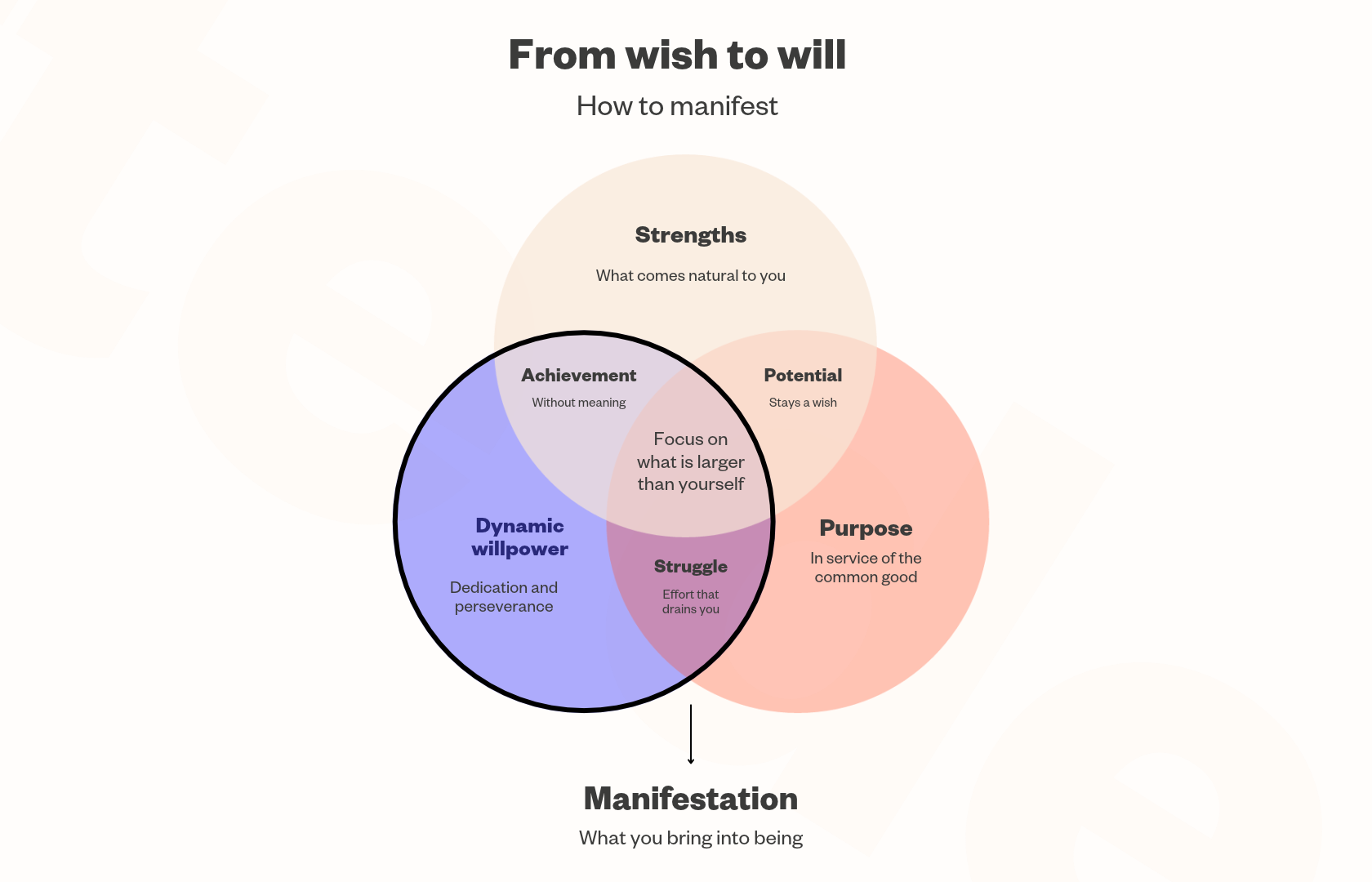
This is the doing part of manifesting. Understanding yourself and recognizing a direction become a way of living through what you actually do. Here, we will explore how to keep applying that understanding when things become difficult, how to return after a setback, and how to remain dedicated while allowing your approach to change.
When perseverance becomes difficult
We can respond to difficulty almost without noticing. We put something off, wait to feel motivated again, or move on to the next idea. We may also turn on ourselves: I should be doing more. I need to try harder. Why can’t I just get on with it?
Both can become defaults. We stop paying attention to what would help us in the situation, and repeat a familiar response instead.
Giving yourself to the practice
By dedication I mean giving yourself to something that feels meaningful and right, and continuing to express that commitment in what you do. Perseverance is staying involved through difficulty and setbacks, learning how to respond as you go.
In my manifestation model, these belong to dynamic willpower: dedication and perseverance, consciously applied and renewed. I call it dynamic because you remain consciously involved in applying it. Even though you may develop habits, you do not simply default to continuing in the same way. In that sense, perseverance also requires replacing default with intention. You return to what your actions serve, notice what the situation asks of you, and choose how to respond.
Successful manifestation of your life and intentions requires real effort. Concentration, repetition, patience, and doing something you do not immediately feel like doing can all be part of it. Working with your strengths does not mean every task will come easily. And surrender does not remove the need to act.
Full engagement means being present in what you are doing, while remaining aware of how it serves your purpose. We can spend hours on something while being distracted, rushing to finish, or thinking mostly about what it will lead to. Giving ourselves fully to the activity is how what matters to us becomes part of the life we are living now.
Your life is happening in what you are doing now. Not just after work, during the weekend, when you finally get to have dinner with friends at night, or whenever the hectic period will finally be over. If we treat what we are doing as something to get through before we can enjoy life, we are wasting it.
Living your path doesn’t require every attempt to feel enjoyable or to succeed. It means being present in everything you are doing now while remaining open to what might present itself. Its meaning can never depend on a possible future result or reward you cannot control.
That is how dedication connects to the attention we bring to this moment, and to surrender at the center of the manifestation model: being fully present in what we do, while remaining open to what unfolds beyond our control.
Returning after a setback
Giving yourself fully to the practice does not mean you will always sustain that dedication. You may skip a practice, miss a deadline, or fall back into an old pattern. It can be tempting to turn that into a conclusion about yourself, like “I never follow through,” which in turn can affect your willpower. The disappointment eats away at your perseverance.
A Berkeley program on happiness at work taught me that self-compassion is one of the ways of supporting resilience when progress is difficult or feedback is unfavorable. Be forgiving to yourself and do not apply a standard to yourself that you would not apply to others. Acknowledge what happened, look at why it happened, and give yourself the grace to return.
In one experiment, students took a difficult vocabulary test and then had an opportunity to study for another. Some received a brief reminder that difficulty was common and that they should not be too hard on themselves. Those students spent more time studying than students who received no such reminder. The finding suggests that responding kindly to difficulty can support renewed effort.
The useful question here is: what would help me return now? A ‘setback’ can show us something we need to understand or change. Dedication means taking that lesson seriously and choosing to continue, without first requiring ourselves to feel that we have made up for the mistake.
Learning through practice
Keeping a simple record can help you see what you are actually doing and where something needs adjusting. A review of 138 experimental studies found that encouraging people to monitor their progress improved goal attainment, and effects were larger when progress was recorded or reported.
For the practice we are exploring here, you could note what you did, what got in the way, and what you learned. If your intention, for example, is to listen more attentively, that might mean recognizing a conversation in which you stayed present, and another in which you began preparing your answer before the other person had finished.
That gives you something specific to practice next time. It also connects perseverance with learning: you remain involved while allowing experience to change how you approach the work.
Remaining attentive
Think back to Butcher Ding, the cook from the Zhuangzi whom I wrote about in my first piece. Even after years of practice, he still encountered difficult places. At a complicated joint, he became cautious, focused his attention, and moved his hand slowly. His skill included recognizing when the situation asked him to change how he moved. This responsiveness develops through training. He practices sensing what is in front of him and working with it.
For me, that is a useful way to understand perseverance. You keep paying attention. Sometimes continuing means trying another approach. Sometimes it means slowing down, resting, or waiting until you can see more clearly. Caring for the foundation of your purpose (The Well) supports your ability to remain engaged.
When success no longer depends on the result
The Bhagavad Gita, an ancient Hindu spiritual text, brings action and nonattachment together. In his commentary, God Talks with Arjuna, Yogananda emphasizes acting while relinquishing attachment to the fruits of action: giving yourself fully to what you do, while letting go of attachment to the result. This is central to karma yoga, the spiritual practice of action without attachment to its rewards.
I see a clear connection with dedication and surrender. We can give ourselves fully to the work without expecting life to deliver the result we imagined. We call something a setback because we measure it against where we thought we should be going. But our life has not moved backward. The experience has become part of us, changing what we understand and what we bring to whatever comes next. That is growth, even if it does not look like improvement in the direction we expected.
Just as time, in this physical world, only moves forward, never backward, everything that happens becomes part of us and what we bring to the next moment. Even if we label something a setback based on our expectations, our envisioned future, it can never be anything but progress. We may or may not see how it has made us grow or how it will benefit us along the way. It’s still there. Life may just develop differently from what we imagined.
Nothing was wasted. Nothing needs to be “a shame.” There is no need for regret.
That changes what success means. If the worth of what we do does not depend on reaching a particular result, we can recognize it in the experience itself: in participating, discovering, and becoming. Even a difficult experience belongs to that process. There is something in every moment worth paying attention to, rather than dismissing it as an obstacle to the life we wanted.
This realization, this understanding, I see as the key to perseverance. When we learn to recognize growth in what happens, rather than measuring against an expected result, our motivation always has a foundation, even when things go differently. We remain dedicated because the experience itself always has worth. Finding that worth helps us continue, and continuing allows further growth. It becomes a positive cycle that makes perseverance natural. We do not have to wait for a particular outcome to feel that giving ourselves to it was worthwhile. We know it is as long as we are present.
Staying dedicated while changing course
Purpose can be expressed in many ways. My purpose of showing others their beauty and strength, and thereby setting off chain reactions so they do the same for others, might take form through writing, bringing people together, or a conversation. A particular project is one way of expressing it.
If that project becomes unworkable, changing or letting it go does not mean abandoning the intention. Another form may serve it better, or life may bring an opportunity I had not considered.
This is why I prefer to speak of intentions rather than goals. A goal points us toward something to achieve, often a specific or measurable result. An intention can describe what we want our actions to serve: the contribution we want to make, without determining exactly what its result must look like.
That may seem difficult to apply in everyday work. But that difficulty also reflects the narrow understanding of success we have become accustomed to. In a society where success is generally measured through business growth, productivity, and wealth, we learn to judge our work against those results. When we allow success to include understanding, connection, care, and what we make possible for others, we have a much broader basis for recognizing the worth of what we do.
We can still make plans and work toward specific results. But those results do not determine whether the experience was worthwhile. Our intention gives direction to our contribution, while leaving room for it to take a form we could not have foreseen.
Difficulty in itself does not answer whether to continue. It helps to ask what the difficulty is showing you. Is there something to learn, support to find, or an approach to change? Does the intention still feel right, even if this particular form no longer does? Does the form actually still suit the intention? The earlier piece on listening to what feels right offers another way to explore those questions.
In practice
Recognize the worth of what you are doing now. What are you discovering, practicing, or contributing that an outcome alone would not capture?
Breines & Chen (2012)
Harkin et al. (2016)
Zhuangzi (n.d.)
Yogananda (1995)